Tuesday, May 30, 2006
Thursday, May 18, 2006
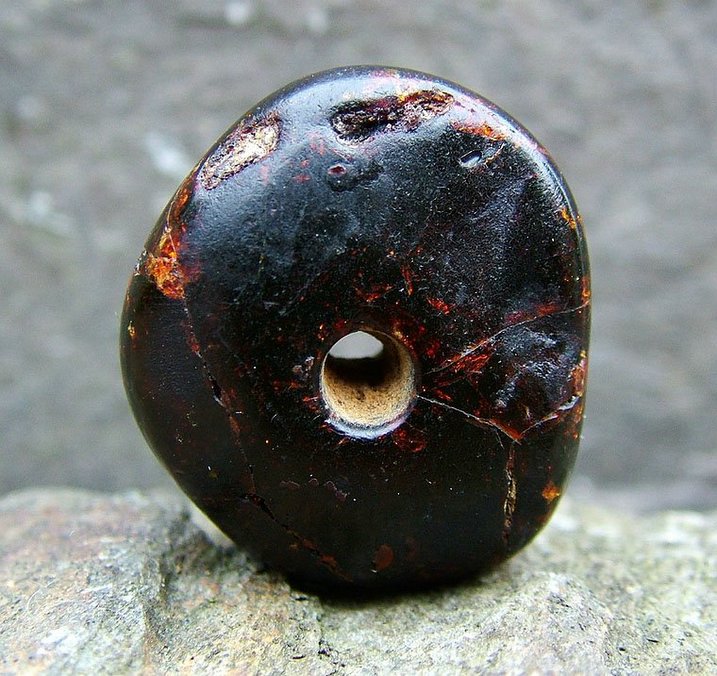
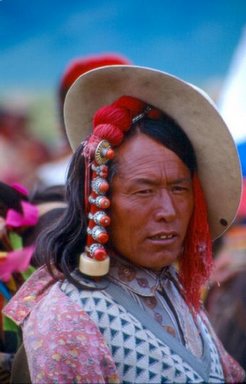
This type of amber headdress is known in Tibetan as Pöden. The Pöden is considered one of the main hair adornments of a married woman. It is made up of a cross shaped crown which rests on the head that can easily be removed. This is richly decorated with large perforated amber pieces which are usually adorned with red coral. Sometimes this head piece will have many strands of coral beads that hang down the nape of the neck , these beads are then attached to a longer piece of material composed of three sections. This piece of material can reach several feet in length and is richly decorated with amber, coral, turquoise and even gold. It is usually finished at the bottom with beaded tassles.
Wednesday, May 03, 2006
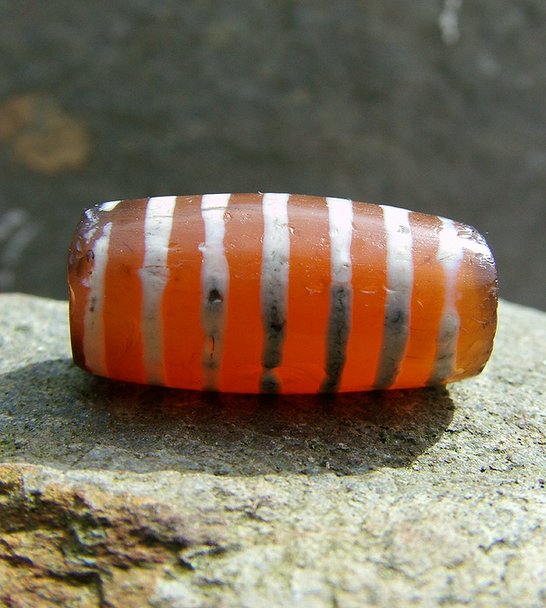
Above: Round Pumtek with six stripe decoration.
The following passage explains (according to the unknown author) how modern day Pumtek are being made in the Hpayargyi Village which is in the Myingyan district of Burma (Myanmar).
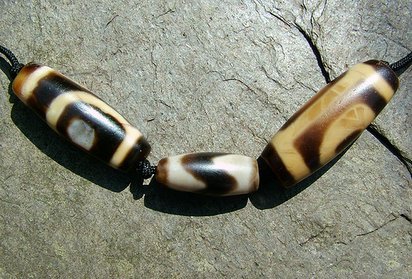
"There are said to be nine stages to the making of a single [Pumtek] bead. First the right type of fossilized stone must be found. This stone must be free of blemishes that occur when white ants build their nests on a piece of wood or have chewed at it. When the right stone has been found then it is cut up into smaller pieces by hand and then put out to dry for seasoning. These cut pieces then are shaped into long beads, flat square beads, oblongs and spheres on the bead-making machine. Once this has been done a hole must be drilled. This is done with a very thin diamond tipped hand drill which is turned and twisted with an instrument shaped somewhere between a violin's bow and a weapon bow. The drill is held by the thread of this instrument which is then pulled to and fro just as a violinist would. It surely needs a sure hand with a lot of skill and practice. The hole is drilled only half way up the bead and then drilling continues from the opposite end, for the two holes to meet in the middle. Any miscalculation would mean two holes that did not meet in the middle or the bead would break or the diamond tip lost. Then the next is the finishing process. The beads are again ground on the roller of the machine after the roller has been painted over with a mixture of melted sealing wax, colouring powder and fine-ground fossil wood powder. Then the beads are washed clean of hand grease and sun dried. In the next stage the bead is held between a pair of tweezers and painted over. The base coat of paint is white with other colours like black and brown to be painted over later. The black paint is a mixture of copper sulphate crystal (Blue vitriol), sulphur, yellow orpiment and human mother's milk. These are all blended together and heated over coals and the heat has to be just right. It is said that animal milk cannot be used successfully to make the paint and that it has to be human milk. After painting the desired colour the last and final stage is to heat the beads again to get a shine on them."
Saturday, April 29, 2006
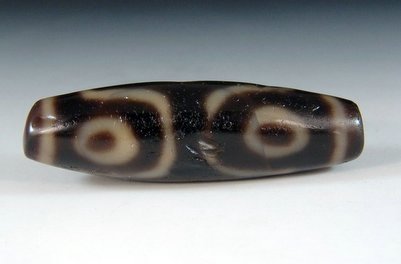
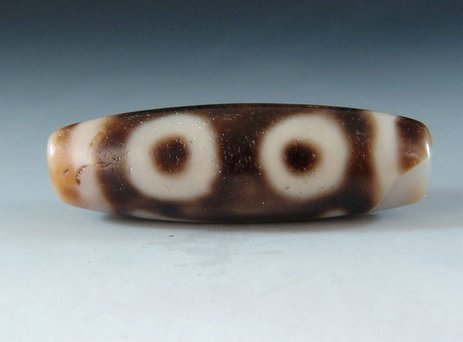
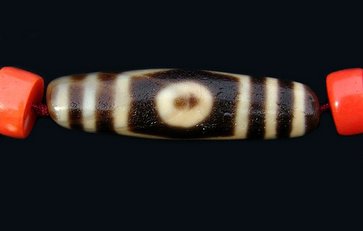
Amongst the many dZi stories known by Tibetans, one common belief is that cattle can give birth to dZi. It is believed that dZi are wormlike creatures that the cattle eat whilst grazing. Once eaten these creatures become petrified, creating a perfect dZi bead. Tibetans also believe that the perforation found on dZi is a completely natural occurance and has not been drilled by man. However, there are some rare dZi that do not have perforations. Maybe these beads were not created to be worn but instead were used to adorn statues and other artifacts.

Tibetan women with beaded hair braids.
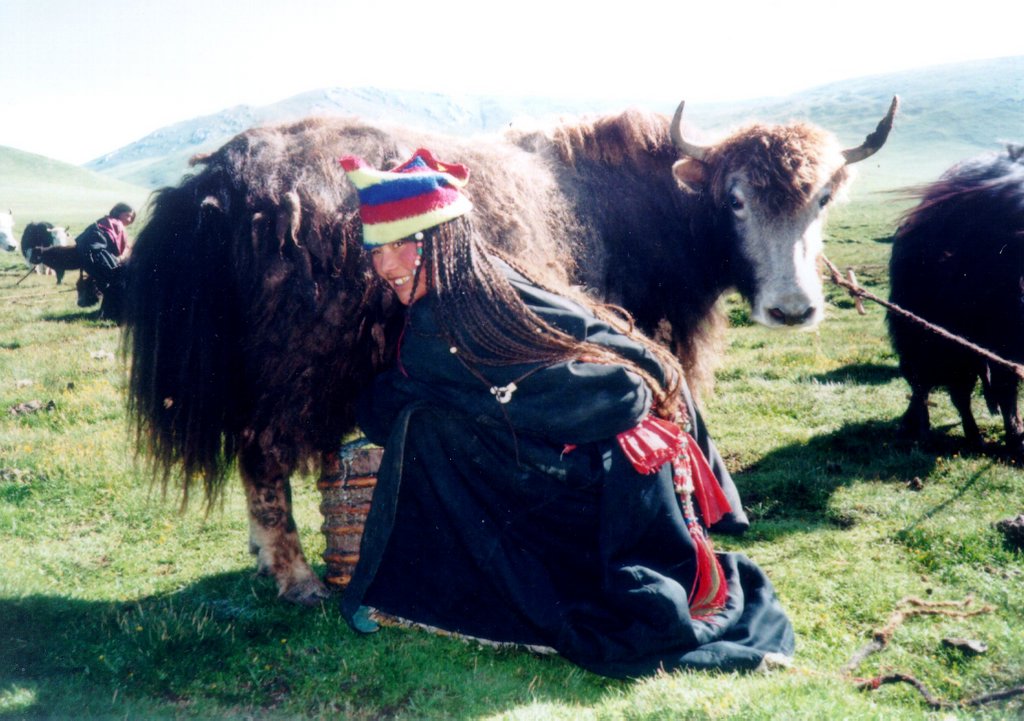
Nomadic Tibetan women often wear their hair in two styles of braids. They may choose to wear it in large braids (slas chen) or small braids (slas zhib). Girls who are unmarried often comb their hair into three large braids and rarely wear ornamnents in their hair, apart from the occasional piece of amber, coral or turquoise. Once a girl is married this will then change as she can now start to wear it in the fashion shown above. This style is called 'Pakma Trale'. These braids are considered a very important part of the wedding ceremony. There are usually 108 braids which is a sacred an auspicious Buddhist number. As a married woman she will start to wear an increasing number of hair ornaments that usually consist of large pieces of amber, coral, turquoise and dZi.
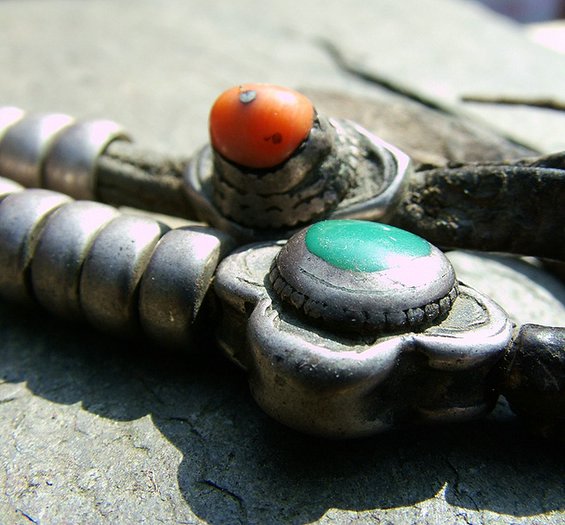
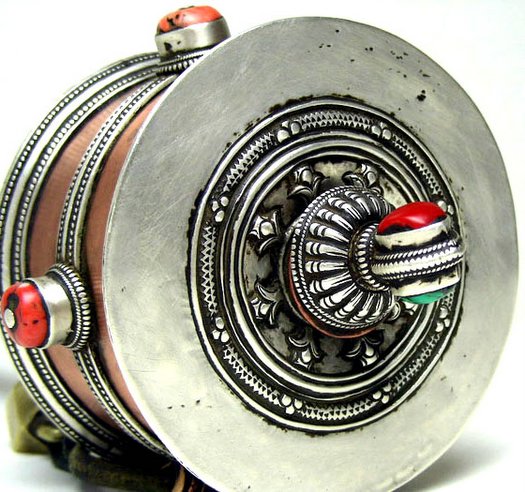
Here we have antique silver counters from east Tibet. They have been inlaid with coral and turquoise. Counters are used to keep track of large numbers of mantra recitations or prayers. They are traditionally strung on 108 bead malas. I have also noticed that some Tibetan traders also use them as a calculator. For this purpose they are simply worn around the neck on a piece of cord for easy access.
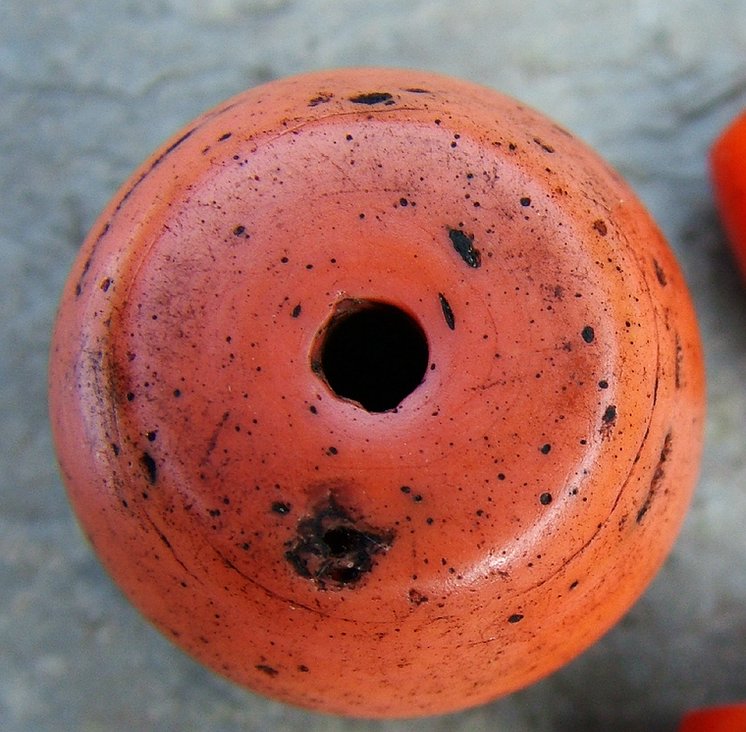
This is a beautiful translucent ancient agate bead. This picture allows us to see how the perforation was made. We can see that the bead was drilled at both ends and that these lines eventually meet to form a complete perforation.
The link below will take you to an interesting article that gives further information on ancient drilling methods.
http://www.lapidaryjournal.com/feature/299str.cfm
The link below will take you to an interesting article that gives further information on ancient drilling methods.
http://www.lapidaryjournal.com/feature/299str.cfm
Photo: The giant Pema Raka bead measures 88.36 mm x 75 mm
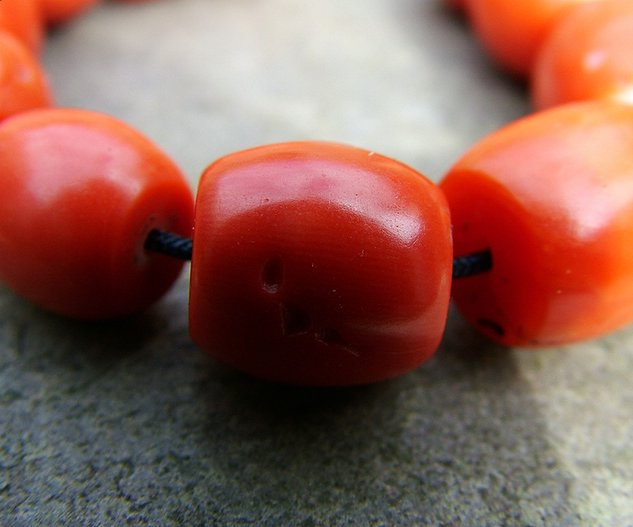
This is an early imitation coral bead made from glass. They are known as 'Sherpa' Coral because they are a popular adornment with the Sherpa women of Nepal. The earliest beads may have been made towards the end of the 19th century and traded as an affordable alternative to genuine red coral. Many are much later creations. In the Tibetan language shar means East; pa is a suffix meaning 'people': hence the word sharpa or Sherpa. In recent years, many of the Sherpa people have migrated to India. Sherpas originally came from East Tibet and migrated to Nepal within the last 500 years.
Subscribe to:
Posts (Atom)